
.jpg)
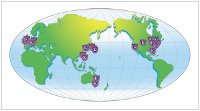
KIST students have been accepted by or have attended universities in the following countries.
KIST Graduates Around the World
K. International School Tokyo (KIST), founded in 1997, is a private, co-educational, non-denominational day school serving the international community of Tokyo from pre-Kindergarten to Grade 12. Conveniently located less than one minute from Kiyosumi-Shirakawa Station in Koto-ku, Tokyo, KIST offers an affordable international education to more than 630 students representing around 50 different nationalities.
In order to prepare students for their adult life, KIST strives to create a safe and caring environment set firmly within a framework that promotes academic excellence through traditional values, a disciplined approach and a healthy lifestyle. The three guiding principles of Respect, Responsibility and Safety overarch all aspects of school life. All students are required to abide by the school dress code by wearing the school uniform and maintaining a conservative appearance throughout their enrolment. They are also expected to act in appropriate ways that uphold the name of the school. KIST students possess high academic aspirations and the desire to continue “Learning for Life” after they graduate. They also demonstrate their compassion by acting on their desire to help others in need and believe that such actions can make the world a better place.
As an international school, KIST welcomes students of all nationalities from “internationally minded” families who can demonstrate a commitment to our vision, mission, educational philosophy and learning programs. The current student population includes approximately 25% American/Canadian/Australasia, 22% Japanese, 15% UK/European, 15% Indian, 12% other Asian and 11% African/Middle Eastern/South American students. Specifically, KIST caters for:
Authorized as an IB World School by the International Baccalaureate, KIST was the first school in Tokyo and the second school in Japan to offer all three IB programmes: the Primary Years Programme (PYP), the Middle Years Programme (MYP) and the Diploma Programme (DP). This ensures a consistent approach to teaching and learning across all levels and provides a continuous progression for students from the time they join the school in kindergarten until they graduate at the end of Grade 12. Furthermore, for families moving around the world, it also offers an attractive benefit in that it allows children to learn within a basic framework used by other IB schools worldwide.
At all levels, an inquiry-based approach provides students with opportunities to take responsibility for their own learning. Subject areas are integrated where possible into units of inquiry that allow students to acquire knowledge and skills through the context of an ongoing search for meaning and understanding. Priority is placed on developing understanding of concepts and application of knowledge and skills in context. We explicitly teach the skills of understanding, research and inquiry, including how to locate, evaluate and apply information. Through this approach, our aim is for students to become independent learners who have the skills to source and evaluate information in order to make informed, responsible choices throughout their lives and to make a meaningful contribution to the community.
English is used as the language of instruction at all levels of the school, however, English is not taught as a foreign language. With the exception of very young children, students must have reached a certain level in English already in order to enter the school. In particular, secondary students must have a high level of ability in order to cope with the demands of studying specialized subjects in English. To meet the needs of non-native English-speaking students whose level of English is lower than is necessary to access the school curriculum independently, language support is provided throughout the school. The type of support provided varies depending on the grade level of the students. It is important to remember that KIST is not an English conversation school.
In addition to the regular curriculum, students at KIST enjoy a variety of co-curricular activities including a range of after-school sporting and cultural clubs, excursions, school concerts and festivals, camps and more.
School history
The table below highlights some of the major events held and milestones reached during the school's more than 25-year history.
| 1997 | April | K. English College founded at Higashisuna, Koto-ku as an English language school |
| Early childhood program began | ||
| September | Official foundation as an international kindergarten | |
| Name changed to K. International College | ||
| November | Affiliated with the European Council of International Schools (ECIS) | |
| 1998 | September | Elementary School opened for Grades 1 and 2 |
| 1999 | April | Name changed to K. International School |
| August | KIS Building completed (campus expanded to two buildings) | |
| September | Elementary School expanded to Grade 5 | |
| October | Authorized by ECIS as an associate member | |
| 2000 | July | Recognized by the Tokyo Metropolitan Government as an educational foundation |
| September | Name changed to K. International School Tokyo | |
| Secondary School opened for Grades 6 to 9 | ||
| 2002 | January | IB Primary Years Programme authorization received |
| 2003 | June | IB Middle Years Programme authorization received |
| Affiliated with the Council of International Schools (CIS) as a regular member | ||
| September | Grade 10 began | |
| 2004 | June | IB Diploma Programme authorization received |
| September | Grade 11 began | |
| 2005 | September | Grade 12 began |
| 2006 | June | Inaugural Grade 12 graduation ceremony held |
| September | Campus relocated to Shirakawa, Koto-ku | |
| 2007 | April | 10th anniversary celebration held |
| 2008 | October | IB PYP, MYP and DP Workshops in Tokyo held at KIST |
| November | Construction of West Building began | |
| 2009 | August | West Building opened |
| October | KIST's official newsletter became known as The Comet | |
| 2010 | January | Artificial turf installed on main playground |
| September | LEAP (Learning Enhancement Academic Program) began | |
| KIST Scholars' Awards first awarded (for the 2010-11 school year) | ||
| 2011 | April | Visited the Tohoku region to support those affected by the Great East Japan Earthquake |
| 2012 | April | EIC (English Intensive Class) began for Grades 6 to 8 |
| June | Inaugural performance of the school song, "For Tomorrow" | |
| September | KIST 'Learning for Life' University Support Scholarships first awarded (for the 2011-12 school year) | |
| 2013 | May | Granted approval as an International GCSE examinations center by Pearson Edexcel |
| 2014 | August | K. International Preschool (KIPS) opened at Nihonbashi-Hamacho, Chuo-ku for 2- to 4-year olds |
| 2015 | January | Granted candidate status for accreditation by the Council of International Schools (CIS) |
| July | Graduates from the 'Class of 2015' achieve an average DP score of 36 points, making KIST the highest ranking DP school in Japan for the first time | |
| 2016 | October | K. International Preschool (KIPS) relocated to Morishita, Koto-ku and re-opened for 0- to 2-year-olds |
| 2017 | February | Granted full accreditation by the Council of International Schools (CIS) |
| October | 20th anniversary celebration held ("K.20 Celebration") | |
| November | Granted membership of the East Asia Regional Council of Schools (EARCOS) | |
| 2018 | August | Granted membership of the Japan Council of International Schools (JCIS) |
| 2019 | May | Granted approval as a Cambridge International School by Cambridge Assessment International Education |
| August | IGCSE curricullum introduced for Grades 9 and 10 | |
| Teacher Development Scheme commenced | ||
| October | Ranked in the Global Top 50 IB Schools by IB-Schools.com for the first time (at #12) | |
| December | KIST Facebook page opened | |
| 2020 | February | KIST Instagram and Twitter pages opened |
| March-June | Distance learning program implemented during COVID-19 pandemic | |
| December | Ranked at #13 in the Global Top 100 IB Schools by IB-Schools.com | |
| 2021 | October | Ranked at #7 in the Global Top 100 IB Schools by IB-Schools.com |
| 2022 | April | Original school gymnasium demolished |
| May | New KIST and KIPS emblems introduced | |
| August | 25th anniversary celebration held | |
| KIST Lower Secondary Programme (LSP) introduced for Grades 6 to 8 | ||
| September | Construction of new Main Building began | |
| November | Ranked at #5 in the Global Top 100 IB Schools by IB-Schools.com | |
| 2023 | December | Ranked at #5 in the Global Top 100 IB Schools by IB-Schools.com |
| 2024 | January | New Main Building opened |
 |


|
| ©2020 K. International School Tokyo 1-5-15 Shirakawa, Koto-ku, Tokyo, Japan 135-0021 Tel: 03-3642-9993 (English) 03-3642-9992 (Japanese) Fax: 03-3642-9994 | E-mail: info@kist.ed.jp |
