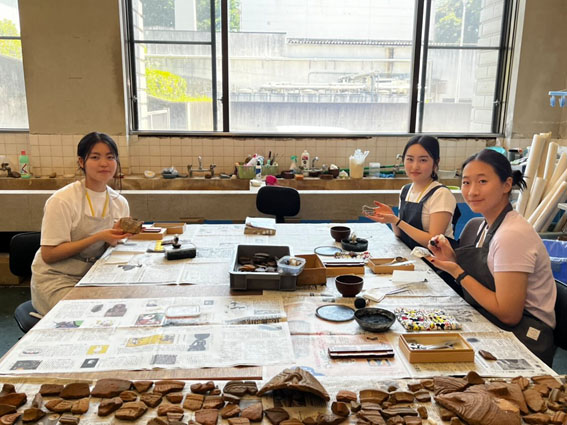
On June 18, we were entering the National Museum of Japanese History (国立歴史民俗博物館), through the back door, looking into the researchers’ personal rooms and labs, learning what happens behind the scenes of the one and only ethnic group museum in Japan.
The school and the museum had organized and given us an opportunity to do a 1-day internship for myself (Kanade G11A) and two other students (Amy G12A and Xintong G10B) from our school. The museum focuses on Japanese history and culture from ancient times to the modern era, combining historical artifacts, and academic research. On the day of the internship, we had done three main tasks: restoring the shape, size and patterns of historical artifacts, assisting with exhibitions, and doing a bit of office work.
In the morning, we got an exclusive tour of what happens at the museum behind the scenes, where the professors were researching their own area of history, they had little pods to work in, which were piled with dozens and dozens of books. We also saw the lab area, where there was a scientist that was experimenting. Later, after the insider tour, the three of us had the opportunity to work with professionals who restore pots from the Jomon time, taking prints of the pattern on the pots.
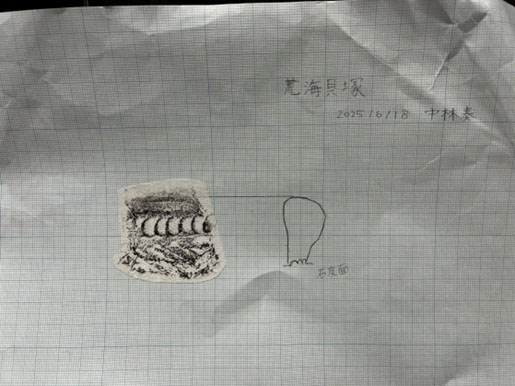
This is an example of one of the prints that we took of a piece of pot from the Jomon time. The process was called doki-no takuhon (土器の拓本) , where we took a damp piece of paper, sealed the shard, then used black ink to investigate the size and the pattern, without destroying the artifact itself.
In the afternoon, after we had eaten lunch, we went over to help out with operating the museum, where we helped guide a group of elementary students visiting the museum for their field trip. During this time, we were able to interact with the students, guiding them around, teaching them manners at a museum. As we got this opportunity to guide the students, we were also able to learn about what the workers do at the museum to maintain order and operate, such as handling the front desk work for a little while.
One key memory I personally have from this day is how one of the workers told me to translate a phrase, “Kannai-de gamu wa kinshi desu” (館内でガムは禁止です), which she wanted to translate as a lot of tourists who do not speak Japanese come. This interaction at first seemed like a simple task that I was asked to help with, but now reflecting, this single interaction may have encompassed the whole of the experience I had at the museum. I told her it can be translated to “gum is not allowed inside of the museum”, which I thought it was an important phrase to translate and convey to the non-Japanese speakers as it was important to take precautions in preserving the artifacts displayed in the museum. Even from this little act, I felt privileged and grateful that I was able to contribute to preserving this amazing place, where Japan’s cultural heritage is preserved and appreciated by future generations.
My most memorable learning was when I witnessed how every staff member at the museum valued history deeply. When we learnt how excavated pottery is recorded, re- assembled, and analyzed, I believe we were all overwhelmed by the sheer time and patience required to puzzle together pieces of ancient culture. Coming back to KIST, I would like to uphold the same perseverance for studies, as well as in my history lessons to remember patience when puzzling together pieces of the past.” Amy G12A
While we helped in the museum, there were a lot of people of all ages, walking around and looking at the displays. The children especially seemed to find similarities between artifacts and modern everyday objects, highlighting how we have evolved. It was a very eye-opening experience that taught me the importance of preserving a country’s cultural heritage.” Xintong G10B